
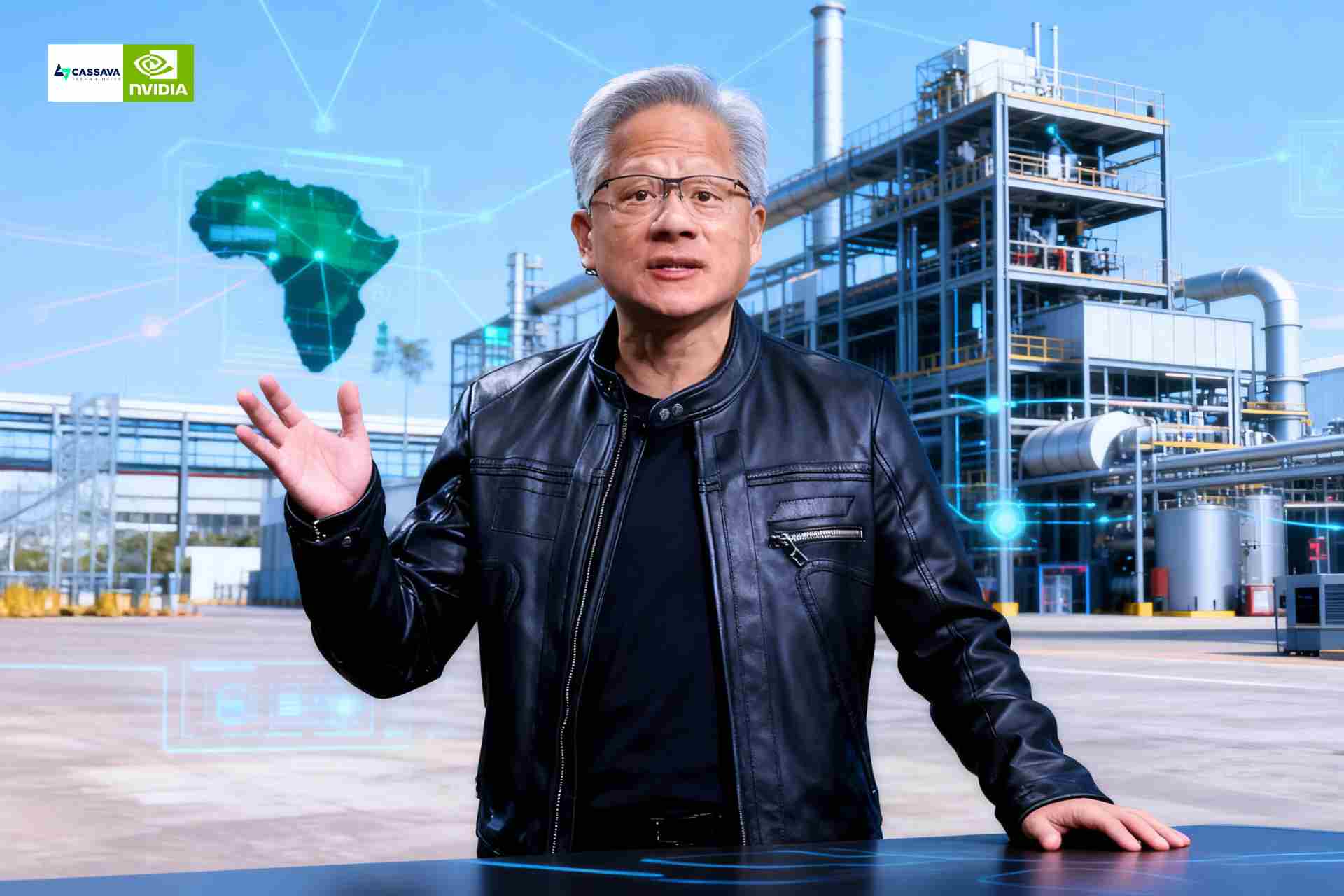
When Jensen Huang, CEO of NVIDIA, teamed up with Cassava Technologies to build what they and others describe as Africa’s “first AI factory,” it wasn’t just another tech announcement. It signals serious moves, for investment, for local capacity, for digital sovereignty. But what this really means, how it may benefit the investment opportunities in Africa, and where risks lie: that’s what matters. Let’s break it down.
An “AI factory” in this case is not robots on an assembly line. It’s a high-security, high-performance data-centre or cluster of them. It will be loaded with GPUs and AI software, meant to train, fine-tune, and run large AI models locally.
Key objectives: reduce latency, keep data in Africa (for sovereignty, compliance), enable local innovation. According to Cassava, the hardware will follow NVIDIA’s Cloud Partner reference architectures.
Timeline & Scope
| Claim | Source & Notes |
| 3,000 GPUs in South Africa by June 2025 | Cassava / Data Center Dynamics. First phase launch. |
| 12,000 GPUs across Africa over 3-4 years | Same sources. Expansion planned. |
| US$720 million investment | Cassava / Bloomberg / Data Center Dynamics. |
| Use of NVIDIA reference architectures, accelerated compute, fiber-optic network, sustainable data centres | Cassava’s own announcement and DCD reporting. |

Here are relevant, up-to-date numbers from SAP and other analysts that give context:
So these business opportunities in Africa aren’t theoretical. From startups to governments, infrastructure to regulation, many players are positioning now.
Here are what the gains could be and why they matter:
Here are what could slow or derail the vision:
These are details not fully disclosed as of now, knowing them would help assess feasibility and risk more precisely:
Image 5- Inside image
If the project succeeds, here’s where value could be unlocked:
What this really is: more than hype, more than a slogan. If done well, this could shift how AI develops in Africa: more locally, more sustainably, with more people participating. But it’s not guaranteed. From mid-2025 onward, watch for whether deliverables match plans. GPU deployments on time, energy and regulation challenges handled, pricing accessible, trust built.
For anyone interested in investing or building in Africa: infrastructure + AI is one of the most promising frontiers. But you’ll want to focus on the details. With right risk mitigation, the ripple effects could reach agriculture, healthcare, finance, public service. If it’s done poorly, costs or missed expectations could lead to disillusionment.
Disclaimer: This content is provided for general informational purposes only. It is not intended as investment, financial, engineering, or legal advice. While sources are cited, figures and project details may change over time. Readers should verify with official energy agencies, government publications, or professional advisors before relying on this information.
Sources:
1. Who is Jensen Huang and what role is he playing in Africa’s first AI factory?
Jensen Huang is the co-founder and CEO of NVIDIA, the company behind the world’s most widely used AI chips and platforms. In the case of Africa’s first AI factory, he isn’t building it himself but playing a pivotal role through NVIDIA’s technology and reference architecture. Huang’s support signals global credibility, while Cassava Technologies leads the on-ground execution across Africa.
2. What do you need to know about Africa’s first AI factory?
The AI factory is essentially a large, high-performance data centre in South Africa, set to launch by June 2025 with 3,000 NVIDIA GPUs. Over the next 3–4 years, the plan is to expand into other countries like Nigeria, Egypt, Kenya, and Morocco, eventually reaching 12,000 GPUs. Its goals: reduce latency, keep data local for sovereignty, and make advanced AI resources accessible for startups, researchers, and governments across Africa.
3. What AI does Jensen Huang use?
Jensen Huang doesn’t personally “use” a single AI system, his company, NVIDIA, builds the hardware and software platforms that power most state-of-the-art AI today. Their GPUs and CUDA software ecosystem are behind everything from ChatGPT to medical imaging models and self-driving car algorithms. For Africa’s AI factory, NVIDIA’s own AI software stack and reference architectures will shape how the infrastructure runs.
4. Does Nvidia’s Jensen Huang emphasize India’s potential to lead the AI revolution?
Yes. Huang has repeatedly spoken about India’s position as a future AI powerhouse, citing its vast pool of developers, strong IT services sector, and government focus on digital infrastructure. He argued that India could become the “largest exporter of AI expertise,” while Africa represents a chance to build local AI capacity closer to the data and communities it serves.
5. What sectors are expected to benefit first from this AI factory?
Early impact is likely in sectors where AI can address immediate local needs:
These sectors already show strong demand for AI solutions in Africa, so local compute power could make a measurable difference.

Walk through an industrial park outside Nairobi and then spend an afternoon in a fintech office in Lagos, and you get two very different pictures of where Africa’s growth is coming from. One is stacked with pallets, packaging lines, and freight schedules. The other runs on laptops, cloud servers, and mobile transaction data. Both are […]

Walk into an investment conference in Nairobi, Lagos, or Cairo this year and the tone has shifted. Investors are no longer asking whether Africa is worth watching. They are asking which sector, which corridor, and which partner will get them in early. Africa’s investment landscape is evolving quickly, shaped by economic reforms, technological innovation, infrastructure […]

Africa’s investment story looks different in 2026 than it did five years ago. Growth is broader, capital is more selective, and the countries drawing serious long-term attention are the ones backing up their pitch with actual policy reform rather than promises. The continent’s real GDP growth accelerated to 4.2% in 2025, up from 3.1% the […]